The following proposal is submitted as a full naming application in accordance with the Naming rules for places in Victoria and relates to the naming of a newly created, pedestrian-only thoroughfare within the 111 Lorimer Street development in Docklands, Victoria.
This proposal outlines the proposed name, location, naming significance, and environmental relevance of ‘Birdsong Walk’, reflecting the site’s connection to nature, landscape and biodiversity strategy to attract birds to the site.
We’re proposing the name ‘Birdsong Walk’ to reflect the area’s biodiversity, specifically the many bird species that inhabit the area.
Australia is recognised as the ancestral home of the world’s songbirds and supports a remarkable diversity of songbirds, many of which are familiar within Melbourne’s urban environment.
It is a positive, non-controversial name that contributes to a cohesive and place-responsive identity for the new residential community.
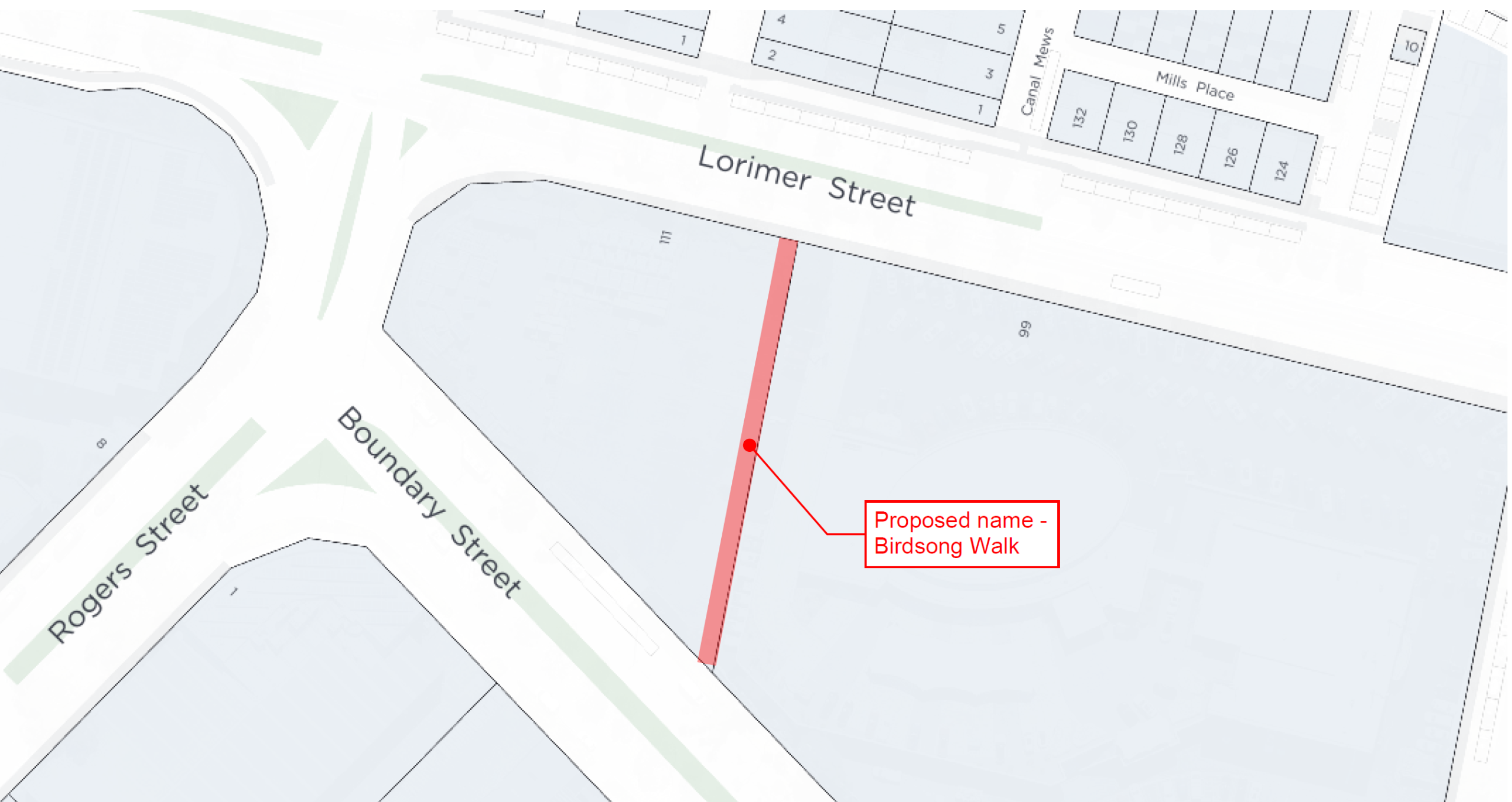
Area proposed to be named Birdsong Walk
View on Google Maps
Naming proposal for Birdsong Walk
Address: 111 - 119 Lorimer St, Docklands, Victoria.
LGA: City of Melbourne
Developer: MONNO Lorimer Developer
Incorporated Document: Specific Controls for 111 Lorimer Street, Docklands - November 2022
Relevant Condition: 4.27 - Section 173 Agreement for Public Access to pedestrian Laneway
Proposed Name: ‘Birdsong Walk’
The following proposal is submitted as a full naming application in accordance with the Naming Rules for Places in Victoria (2022) and relates to the naming of a newly created, pedestrian-only thoroughfare within the 111 Lorimer Street development in Docklands, Victoria.
This proposal outlines the proposed name, location, naming significance, and environmental relevance of ‘Birdsong Walk’, reflecting the site’s connection to nature, landscape and biodiversity strategy to attract birds to the site.
It also demonstrates compliance with the City of Melbourne’s Place and Road Naming Policy, aligning with broader place-making objectives and statutory naming requirements.
The submission concludes by addressing each of the relevant principles for road naming, ensuring that the proposed name meets both state and local guidelines for clarity, public safety and environmental context.
Condition 4.27 of the Incorporated Document - November 2022, requires a 3-metre-wide pedestrian laneway on the eastern side of the development is to be vested to City of Melbourne (as roads under the provision of the Subdivision Act 1988).
As such, the new road must be formally named to ensure appropriate street addressing for future residents and the general public.
Contextual Naming Strategy – 111 Lorimer Street, Docklands
‘Birdsong Walk’ (highlighted in orange in the Figure 1 below) is the name proposed for the publicly accessible pedestrian laneway running north-south, connecting Lorimer Street to Boundary St along the eastern boundary of the site.
The proposed name has been selected in promotion of nature, landscape and biodiversity, design pillars which have informed the development and align with both Council policy and the Naming Rules for Places in Victoria (2022).
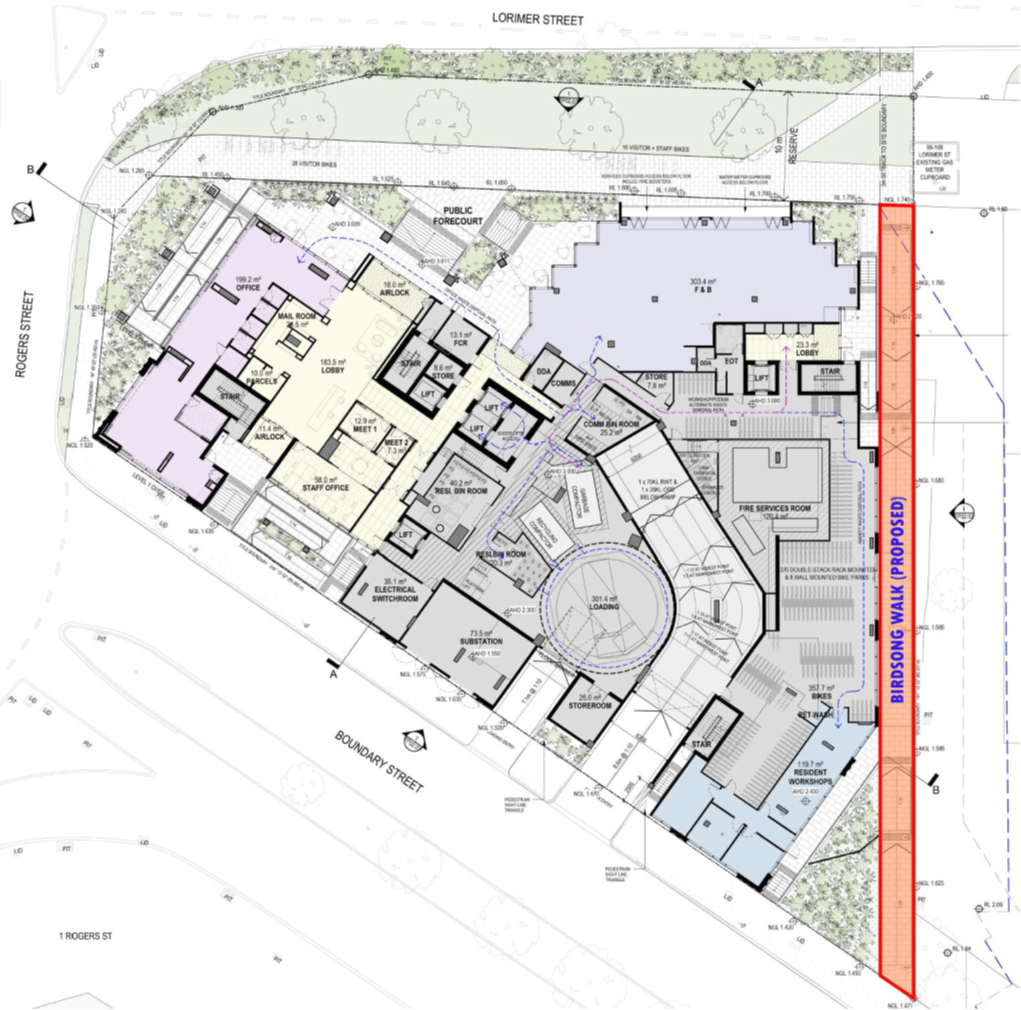
Figure 1 – 111 Lorimer Street, Docklands Ground Floor plan showing the pedestrian laneway ‘Birdsong Walk’.
The pedestrian laneway (to be vested to City of Melbourne as a Road) being proposed for naming, runs northsouth on the eastern edge of the site connecting to Lorimer Street (northern edge of the site) to Boundary Street (southern edge of the site).
Throughout the planning, design development and Greenstar process MONNO engaged Nature Collective (Stephanie Sirianni) and Woop Woop for Nature (Elisa Raulings) as consultants to inform the biodiversity strategy and landscape plant selections.
The proposed name ‘Birdsong Walk’ pays tribute to the site’s contribution to biodiversity through a selection planting on the ground floor plan, with a specific focus on plants that attract songbirds such as Chocolate Lily (Arthropodium strictum), Native Fuschia (Correa) and Hop Bush (Dodonaea).
Australia is recognised as the ancestral home of the world’s songbirds and supports a remarkable diversity of songbirds, many of which are familiar within Melbourne’s urban environment.
A number of songbird species have been recorded locally and are likely to utilise planting and green spaces surrounding the site. These include Red Wattlebirds, Welcome Swallows, Willie Wagtails, Mudlarks (Magpielarks), White-plumed Honeyeaters, New Holland Honeyeaters and Superb Fairy-wrens.
Songbirds are renowned for their highly developed vocal abilities, producing complex and learned songs that play a central role in communication, territory and social behaviour. Collectively, they contribute significantly to Melbourne’s distinctive urban soundscape and biodiversity.
The planting strategy provides diverse habitat structure and year-round resources, rather than targeting a single plant species. Correas (Native Fuchsia) and Lightwood are particularly relevant and present at the ends of the laneway, as they provide both food and perching opportunities for songbirds.
Other food plants (e.g. Banksias) are located elsewhere on the site but still contribute to overall habitat use.
Insect-attracting plants also indirectly support songbirds through prey availability.
Research into songbird behaviour highlights several characteristics that are directly relevant to this laneway context:
- Songbirds learn their songs, resulting in local “dialects” that reflect and respond to place.
- Song is used to establish territory and presence through sound rather than movement and also plays a role in teaching juveniles while they are still in the nest.
- Birds typically sing from edges — such as trees, fences, overhead wires and building margins — rather than from within narrow planted corridors.
The laneway and landscaping have been specifically designed to provide a sheltered and quieter space where birdsong can be heard more clearly, allowing pedestrians to encounter this characteristic element of Melbourne’s urban biodiversity as they move through the space.
Consultation with biodiversity specialists throughout the planning and design of 111 Lorimer Street has informed a laneway naming approach grounded in the site’s environmental character. The proposed name responds to the broader landscape setting within the site, including indigenous and habitat-supporting planting, urban greening initiatives and a landscape strategy designed to attract and sustain local birdlife.
The role of birdsong as an experiential element of place — contributing to the site’s soundscape and reinforcing connections to local biodiversity — has been carefully considered in shaping the proposed laneway name.
By acknowledging the environmental, landscape and acoustic qualities of the setting, the proposed name aligns with the City of Melbourne’s Place and Road Naming Policy in being locally meaningful and contextually appropriate.
Principle A – Ensure public safety
Response in consideration of proposed name ‘Birdsong Walk’ - The proposed naming of the road to be vested to City of Melbourne, provides a clear approach to street addressing for the pedestrian laneway. Its extent is clear and it not a primary entry / access therefore does not present a risk of confusion for emergency services, transport, communication and mail services nor have the potential to adversely affect the operations of these services.
Principle B – Recognising the public interest
Response in consideration of proposed name ‘Birdsong Walk’ - The road being named is part of a new development on the property therefore no current residents, emergency response zones and addresses, property owners, businesses and visitors are adversely affected.
The proposed naming creates clear and unambiguous street addressing for the pedestrian laneway being developed. This will inherently provide improved provision of emergency services, deliveries and other services to the future occupants of the property.
The selection of the proposed name has been thoughtfully considered such that it provides enduring value to the community, with particular focus on linking the name to place as discussed below under Principle C.
Principle C – Linking the name to place
Response in consideration of proposed name ‘Birdsong Walk’ - We are cognisant of the importance of ensuring the preservation of cultural heritage and the proposed name has been selected with this as a core consideration. The biodiversity and landscape design of the new development has been a design pillar.
As the road being named travels through the eastern edge of the site, we are seeking to link it to native flora that attracts birds which is relevant to place. Doing so will strengthen the link the road has to nature and the sites cultural heritage.
The road being named does not qualify as a place of greater than local significance.
Principle D – Ensuring names are not duplicated
Response in consideration of proposed name ‘Birdsong Walk’ - VICNAMES has been used to search for existing uses of the proposed name.
The closest existing use of ‘Birdsong’ is Birdsong Glade in Tarneit; approximately 25km from the new private road being named.
There is also a Birdsong Avenue in Mickleham; 40km from the new private road being named.
Principle E – Recognition and use of Traditional Owner languages
Response in consideration of proposed name ‘Birdsong Walk’ - Traditional Owner language has not been used in the proposed naming of the new road.
Principle F – Names must not discriminate or be offensive
Response in consideration of proposed name ‘Birdsong Walk’ - We have taken into consideration various relevant factors such as extent of usage, historical context, public perception and lexical meanings, in order to ensure the proposed name does not discriminate nor cause offence and we believe the proposed name does not do so.
Principle G – Gender equality
Response in consideration of proposed name ‘Birdsong Walk’ - The proposed name does not present a diminishment of gender equality.
Principle H – Dual names
Response in consideration of proposed name ‘Birdsong Walk’ - As set out in the naming rules, dual names are not applicable to roads.
Principle I – Using commemorative names
Response in consideration of proposed name ‘Birdsong Walk’ - The proposed name is not commemorative of an event, person or place.
Principle J – Using commercial and business names
Response in consideration of proposed name ‘Birdsong Walk’ - The proposed name is not named after a business, commercial entity or anything of that nature.
Principle K – Language
Response in consideration of proposed name ‘Birdsong Walk’ - The proposed name is:
- a single word;
- written in standard Australian English;
- easy to pronounce, spell and write;
- not an abbreviation; and
- compliant with the approved pedestrian-only road types set out in the
- naming rules.
Principle L – Directional names to be avoided
Response in consideration of proposed name ‘Birdsong Walk’ - The proposed name does not incorporate a cardinal direction.
Principle M – Assigning extent to a road, feature or locality
Response in consideration of proposed name ‘Birdsong Walk’ - The extent of the road to be named is highlighted in orange on the attached plan. We have also included the Plan of Subdivision for your information.
We propose approval of ‘Birdsong Walk’ complies with the Naming Rules' broader objectives of placemaking and honouring nature and biodiversity.
We respectfully submit that this proposal is fully compliant with the Naming Rules and exemplifies the kind of context-driven, heritage-focused decision-making these rules were designed to support.
We trust that the material provided presents a compelling case for formal registration, and we appreciate your continued support as we progress this proposal.