We continuously seek community feedback about on-street parking, as specific neighbourhood engagement periods are just one element of our feedback collection. The following feedback relates to specific engagement periods for North Melbourne.
The feedback we received during these engagement periods has informed the improvements we will roll out, and we won’t set and forget the new conditions once works are complete. We'll give the community time to adjust and then review the functionality and performance of those changes.
You can have your say any time on parking in your neighbourhood by completing the 'always on' survey. The next review of your neighbourhood will use this data to inform future changes.
Proposed changes (2026)
The conversation
In 2023, the City of Melbourne introduced a Parking and Kerbside Management Plan (PKMP) that committed to regular reviews of the kerbside parking system based on proactive engagement in local areas and sharing the data that underpins decision-making.
North Melbourne has a range of pressures impacting on-street parking including the opening of Metro Tunnel, affordable housing developments, growing population, Urban Greening projects and more. The neighbourhood has more than 5800 on-street parking spaces, which are managed by the City of Melbourne.
Before we began the North Melbourne parking review, parking conditions in North Melbourne were incredibly varied, including:
- more than 250 types of unique parking signs
- a range of long-stay parking bays
- a range of short-stay bays, including No Parking, Loading Zones, 15 minutes, 10 minutes and 5 minutes
- paid and unpaid parking
- a range of permit areas and some parking that is permit excepted.
This diverse mix means parking conditions across North Melbourne are inconsistent. We've heard from the community that these inconsistencies make it hard to find the right spaces at the right times.
Feedback provided by the community as part of this neighbourhood parking review has informed upcoming parking changes that will be rolled out in North Melbourne. Delivery of these changes will begin in April 2026 and you can read more about the changes at North Melbourne parking improvement works.
Any changes we make to parking conditions won't be 'set and forget' − we will check in with the community annually to review the performance of the conditions and fine-tune them where necessary. Through this process, parking conditions may evolve over several years.
Gathering insights
In North Melbourne, the second phase of engagement was run in February and March 2026.
During this engagement process, we reached out to more than 600 previous participants of the first round of engagement and ran a targeted social media campaign directing people to our survey to provide feedback on proposed parking changes in North Melbourne.
Through this consultation process, we had 127 responses from residents, businesses, workers and visitors whose feedback has helped us plan the next steps.
You can still have your say on North Melbourne parking via our always on survey. You can also learn more about what we heard from the community in the first round of engagement in the next tab.
Annual reviews
Once this round of parking change in North Melbourne is complete, an Annual Review will be scheduled. We'll give the community time to adjust, and we will review the performance of the new conditions each year and fine-tune them where necessary.
Who we reached
We had 127 survey responses from North Melbourne.
This included:
- 79 residents of City of Melbourne
- 16 business owners
- 55 workers
- 46 visitors
We also received direct submissions and heard from a range of stakeholders including employers such as Housing First, Lort Smith, Saints College and North Melbourne Dental.
What we heard
We reviewed all 127 pieces of feedback to better understand what matters most to the community. We looked at the overall tone and key themes raised to understand people’s experiences and concerns with parking in North Melbourne.
Many comments were practical and descriptive, focusing on how people currently use parking and how proposed changes might affect their day‑to‑day routines. Some community members raised concerns, particularly about whether increased paid parking would improve turnover and availability. Others expressed support for the changes and the direction being proposed.
We also analysed feedback by key themes:
We received 42 responses about paid parking, with a diversity of views shared about the potential impact of this kind of parking control. Here are some examples of what people told us:
- “Less paid parking! How are businesses supposed to survive if people can’t pay to visit.”
- “If it’s gonna be paid parking, just limit to when the business is needed i.e. only until 6.30 on weekday and 12.30 on Saturday only”
- “I strongly support the introduction of more paid parking. Paid parking is the only way to ensure this important public space is actually properly valued and rationed.”
North Melbourne has over 5,800 parking spaces, and community feedback highlights strong demand across all user groups, indicating the need for active management. Business patrons and attendees of community activities expressed a preference for more affordable parking with longer stay options. In contrast, residents supported increased restrictions and expanded permit zones to protect access during periods of heightened demand.
Visitor, business and worker needs
We received 28 responses from workers and visitors to key destinations in the neighbourhood. Here are some examples of what people told us:
- “Its a school, should have free parking for School Staff.”
- “Having to attend Peter Mac regularly as a patient the Peter mac car park is always full and I rely on free street parking for 2 hours and more if appointments are delayed. Please don’t make patients pay on top of medical bills and leave three and four hours if getting treated.”
- “After 6pm on Friday nights and all day Sunday − church times! And we shouldn’t have to pay for that!”
Residential exemptions
We received 20 responses from residents in the area which focused on prioritising parking spaces for residents.
- “Commuters and hospital staff are consistently abusing the parking limits, and I often find myself unable to park on my own street.”
- “Make Canning Street Permit only on Sunday mornings. You can’t leave the house for 5 mins without church attendees stealing all the parking spots for miles around.”
We received 51 location-specific responses represented by the icons on the map below.
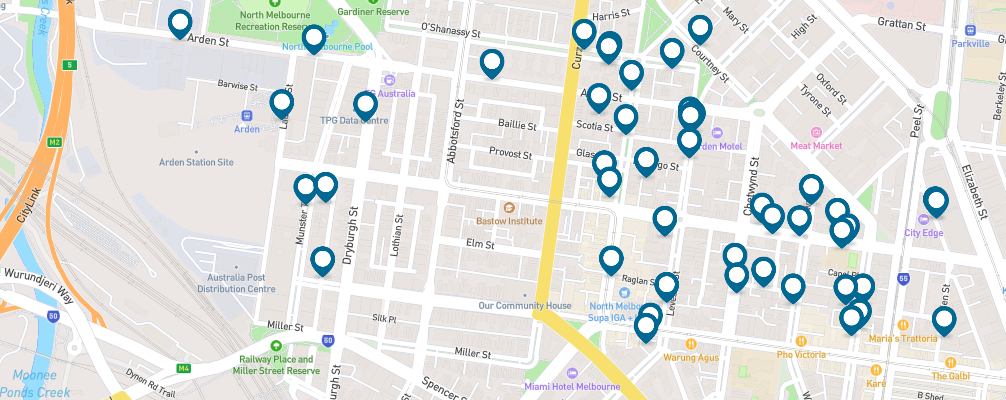
In addition to the key themes identified through community feedback, a range of responses offered broader reflections on North Melbourne’s transport and accessibility landscape.
- “When will the Errol Street park be implemented?”
- “Don’t make Curzon Street paid parking as its residential neighborhood with medium density. It’s already hard to enough to find parking, friends and family use the to visit us.”
Impact
Based on what we heard, we’ve updated the proposed changes to better reflect community feedback. To read about the changes to parking being delivered in North Melbourne, visit our North Melbourne parking improvements page.
Paid parking
We will deliver the new paid parking area to manage high demand based on parking occupancy data.
In the new paid parking area, most paid parking will end at 7pm.
- Parking spaces where existing controls apply after 7pm will become paid, time-limited parking until 10pm.
- Streets with existing controls across 7 days will be standardised as paid parking 7 days, 7am–7pm.
- Typically, streets with an existing mixture of 7 day and weekday controls will be standardised as paid parking 7 days, 7am–7pm.
- All other streets in this area will have paid parking on weekdays (Mon–Fri, 7am–7pm) and will be free on weekends.
Residential exemptions
We will not reduce parking opportunities for resident permit holders in any area.
While 57 full-time Permit Zone spaces will be removed, they will be replaced with a 25% increase in resident exempt bays.
This means more parking bays where permit holders can park without time limits, and increased flexibility to accommodate visitors, carers and non-permit holding residents.
In locations where resident exemptions already exist, and additional parking controls are being added, the number of resident exempt spaces will increase.
Where parking was previously uncontrolled and controls are being introduced for the first time, one side of the street will be resident exempt parking.
Visitor, business and worker needs
We will increase parking flexibility for a wider range of users, including businesses, workers, and customers by removing 57 restrictive Permit Zone spaces and replacing them with an increase of 25% resident exempt bays.
In Area 4, where streets are currently unrestricted, one side of each street will change to 4‑hour parking (4P, resident exempt), the other side will provide all‑day parking. This will support longer stays for local businesses and workers, while reducing parking by train commuters who park in North Melbourne to travel elsewhere.
No new meters will be installed near Arden Station. We will continue to monitor this area for increasing pressure as the new station increases travel to and from the area.
Location-based feedback
All location-based submissions will be assessed through the design process as we make changes on a street-by-street level. When a submission is supported by parking data and policy, changes will be made.
Additional feedback
While some comments fell outside the scope of this review – such as references to public transport, active travel and urban greening – they highlight the community’s interest in coordinated and sustainable solutions. This feedback will be used by a number of teams within the City of Melbourne to inform future strategies and the delivery of parking projects.
To read about the changes to parking being delivered in North Melbourne in 2026, please visit our North Melbourne parking improvements page.
Next steps
We won’t set and forget the new conditions. The community feedback we heard has informed the final design of upcoming parking changes in North Melbourne. Delivery of these changes begins in 2026 and you can read more about the changes on the parking improvement works page.
We'll give the community time to adjust and then review the functionality and performance of the changes. We will be back in North Melbourne to see how these changes are working and hear from community again. At that stage we will also provide an update about the event parking overlay investigations. You can have your say any time on parking in your neighbourhood by completing our always on survey.
First consultation (2025)
The conversation
In 2023, the City of Melbourne released its Parking and Kerbside Management Plan, which committed to regular reviews of the kerbside parking. These reviews include proactive engagement in our neighbourhoods, and sharing the data that underpins decision-making.
For North Melbourne, data was provided, and opinions were sought on the following topics:
- The allocation of kerbside space for parking and other uses.
- Short-stay parking. Defined as bays with a stay limit of three hours or less, to support several arrivals across the day.
- Long-stay parking. Defined as bays with a stay limit of four hours or more, to support one or two arrivals per day.
- Resident parking options, including car-share, off-street private parking and permit systems.
- Enforcement of parking system rules.
Gathering insights
In North Melbourne, the cycle of regular reviews began with a round of engagement starting in August 2025. This engagement included a range of activities to hear from a wide cross-section of the community. This included insights gathered through workshops, intercept surveys, interviews, and survey responses.
You can still have your say on the North Melbourne Parking Review. The ‘always on’ survey allows community members to share their views on parking at any time, rather than only during formal consultation stages. It provides a way to capture both ongoing issues and new challenges as they arise, complementing formal consultation activities. You can have your say via the 'always on' survey at any time.
How we reached you
During this cycle of engagement, we followed the City of Melbourne’s engagement guidelines to deliver accessible and inclusive engagement opportunities for the North Melbourne community. These included:
- Two geo-located paid social media campaigns to target people who live, work or visit North Melbourne. This campaign reached more than 97,000 people.
- Postcards delivered to more than 10,500 registered addresses in North Melbourne directing residents and businesses to our survey to provide feedback. Delivery was completed with a 97.03% success rate.
- Communications sent to all neighbourhood portal subscribers.
- Participate Melbourne news article published and direct email notification sent to sent to 206 subscribers of the North Melbourne Parking Review page.
- Business in Melbourne newsletter sent, with an open rate of 55.49% (5,415 people)
- In-person ‘intercept’ surveys conducted over three days with three field interviewers, targeted across Errol Street, Arden Street, Flemington Road and surrounds.
To receive updates by email about parking in North Melbourne, click the blue 'Follow' button at the top of this page.
Who we heard from
We heard from residents, visitors, businesses and workers across North Melbourne. We gathered feedback from 778 community members during this engagement.

attended by 40 participants.

including workers, owners and delivery staff.

with local businesses, community groups and members, including a sports club, resident association, local school and local community groups.

Forty residents, businesses and representatives attended two in-person workshops. We had representatives from across the business community including health, veterinary and small business owners.
Participants were asked to complete a pre- and post-workshop survey.
- Confidence in understanding of strategic parking planning increased from 29% (pre) to 92% (post).
- 77% of respondents indicated their sentiment towards Council’s parking engagement was more positive
Seven organisations were approached for dedicated interviews. One-on-one interviews with the following stakeholders were conducted:
- Saints College (North Melbourne Campus)
- North and West Melbourne Neighbourhood Centre
- North Melbourne Primary School
- North Melbourne Football Club
- North and West Melbourne Precinct Association.
120 business stakeholders were interviewed in focused intercept surveys. Intercept surveys were collected from a range of industry sectors, including, hospitality (39), professional services (30), retail (26), entertainment/recreation (3), and other (22).
Up to October 2025, 613 responses were received about parking in North Melbourne via the ‘always on’ survey. The demographic breakdown of respondents was the following: 48% identified as female, 46% identified as male, 20% were born overseas, 4% identified as a person with a disability, and 7% as a carer.
What we heard
Resident parking
We received over 80 responses about resident parking, including permits and resident exemptions.
Here are some examples of what people told us:
- “People who aren't on leases, e.g. share houses, find it difficult or impossible to access parking permits.”
- “No free parking makes it difficult for residents even after hours.”
- “Some residents abuse it by parking large trailers attached to large trucks.”
Staff parking
We received almost 50 comments regarding business needs, employee parking and trade service parking.
Here are some examples of what people told us:
- “Not enough parking space for people that work in the area.”
- “My employees either receive regular parking fines or need to leave work constantly to move their car.”
Visitor parking
We received almost 30 comments regarding visitor parking.
Here is an example of what we heard:
- “Friends visiting during the day is impossible.”
Time limits
We received over 140 comments regarding the need for increased short-stay time-limits (such as 1P and pick up/drop off areas). We received an additional 59 comments regarding long-stay parking options (such as 3P and P).
Here are some examples of what people told us:
- “Errol St shopping area should have more free 15-30min parking spots”
- “There is NO capacity for residents with multiple vehicles to park in the street long term. This is a ridiculous oversight and inconvenience meaning cars are moved every 2-4 hours”
Evening and weekend restrictions
We received over 110 comments regarding evening and weekend parking restrictions.
Here are some examples of what people told us:
- “I fail to see why there is no timed parking in our street when people from the hospital and schools park there all day.”
- “Evening visitors often cannot find a park and a parking time limit of one hour is too short.”
Enforcement and misuse of parking spaces (poor signs and line marking)
We received over 50 comments regarding inconsistency in enforcement, resulting in misuse of parking.
Here are some examples of what people told us:
- “Lots of non resident parking in spots all day without enforcement. Makes it very hard for short stay visitors / residents to use the spots.”
- “Parking signs are generally not easy to read and seem to be designed for parking inspectors to give out more parking fines.”
Parking uses
We received almost 90 comments regarding parking uses such as, loading zones, pick up/drop off (PUDO) and accessible bays.
Here is an example of what we heard:
- “Review loading bays not in the industrial area anymore.”
Late-night access
We heard about safety concerns and requests for close-by parking for shift workers, residents and visitors to avoid late-night walking.
Here is an examples of what people told us:
- “I don’t feel safe coming home at night.”
Trade services parking
We received almost 40 comments about increased parking demand from developments.
Here is an example of what people told us:
- “It's often full of tradies working on building sites, and hospital workers who can't afford/don't want to pay for parking.'
Impact
Community feedback received through this engagement will inform the development of proposed parking changes in North Melbourne, ensuring they reflect local needs and priorities.
These proposed parking changes will also be informed by parking data collected during this engagement period, in line with the Parking and Kerbside Management Plan.
Next steps
We will be back in North Melbourne in early 2026 to share the proposed changes to parking and hear from community if we have got the balance right.
We won’t set and forget the new conditions once works are complete; we'll give the community time to adjust and then review the functionality and performance of the changes. We will undertake a comprehensive review of how these changes through the regular review cycle.
Read the engagement summary report


Background feedback
Feedback from other projects where we heard about parking in North Melbourne.
What we heard from North Melbourne projects
We have supported and worked with a range of projects across North Melbourne, and many have received feedback on parking. This has been collated by our team and will be used to support our in-person engagement and first round of changes.
We have received 93 responses as of June 2025:
25 submissions to reduce parking space for other uses (greening, bike lanes, pedestrian access)
- "There are way too many car parks in certain streets. These should be prioritised as green corridors."
- "Almost all parking can be repurposed for better things – remove it!"
20 submissions regarding lack of parking availability
- "Friends won’t visit if there isn’t good parking. Let’s not fool ourselves that the world is all walking and cycling. The older one gets, the more important the parking."
- "The reduction in parking, combined with non-compliance with parking time limits and lack of council enforcement, has significantly impacted parking amenity in and around Arden Street."
13 submissions on the need for updates or adjustments to resident exemption parking
- "As a resident living on the city fringe, I struggle with competing for parking space with construction workers who park illegally all day, and other short term city/hospital visitors."
- "There are cars with permits parking here during the day only, and I do not believe they are residents of this immediate area."
Parking services staff worked closely with the team to develop FAQs and take on key feedback from traders and residents.
Errol Street received 1196 survey submissions with 219 (18%) referencing car parking.
Key themes
- Overall support of adjustments to create more open space.
- Concern from traders about access to parking for workers and customers.
- Concern from locals about congestion.
Quotes
- "I’m very excited by this plan and think this will hugely improve the area."
- "Traffic is already congested and there is barely any parking. With the other proposed plans to take away a parking lot where is everyone going to park? Everyone utilises the space we have, no need for more."
Parking services staff attended in-person pop-ups regarding affordable housing sites and participated in the Community Reference Group sessions to provide parking updates.
Victoria Street Affordable housing received 1964 survey submissions with 379 (19%) referencing car parking.
Key themes
- Lack of available car spaces for all users, residents, businesses, workers and visitors in the precinct.
- 47 spaces within the car park is a loss for locals.
- Parking reporting indicates 47 spaces can be supported by the kerbside parking network.
Quotes
- "Car parking lots are a terrible use of urban space."
- "Parking has always been a challenge for my patients and it has been getting worse with the increase of residential developments in the area."
Parking Services staff helped facilitate reference group work for the Royal Park Master Plan as well as sit on the ongoing Working Group for development of the plan.
Royal Park Master Plan received 4622 survey submissions with 530 (11%) referencing car parking.
Key themes
- Parking in a park should be reduced.
- Parking for key activities such as the zoo, recreation and sports needs to be managed well.
- Accessibility and access needs to be considered when designing parking in Royal Park.
Quotes
- "Drivers pollute the park and make it more dangerous for other park users."
- "Parking is awful; I avoid it by usually walking there."
- "Parking not acceptable at pavilion - elderly and disabled spectators not catered for."
Parking services staff attended in person pop-ups regarding works on Chapman Reserve.
Chapman Reserve received 301 survey submissions with 34 (11%) referencing car parking.
Key themes
- Existing pressure on parking for residents needs to be addressed.
- Parking around busy areas (hospitals and schools) needs to be reviewed.
- Residents find it difficult to park in their street.
Quotes
- "There’s always an issue with parking especially on school time."
- "There is insufficient car park spaces at the present moment, especially during working days. The proposal will remove a number of car park spaces, thereby making the car parking situation worse."
We know there are a range of infrastructure, housing and transport projects being undertaken by the State Government across North Melbourne. These include the West Gate Tunnel Project, tram updates, Affordable and Public Housing changes, and health precinct works.
We work closely with these teams to manage parking and are monitoring these changes to align parking works with the delivery of key changes across North Melbourne.
Key themes from feedback
Several key themes have emerged from feedback to date:
- Need for better parking availability across key locations for both residents and businesses
- Consideration of kerbside parking space for other uses in key locations
- Residential permit exemptions and system updates
- Review of key usage and space allocation of Accessible Bays and Loading Zones
- Key land usage such as hospitals and schools need to be reviewed.
We know that parking bays across North Melbourne support on average 5 arrivals per day. In the CBD that number is 23 per day.
By reviewing and updating the various controls such as time restrictions, length of stay or permit exemptions, we can look at incremental increase in arrivals in a bay which means parking is working for more people more often.