Case studies by neighbourhood
Hear from residents across our city about how they have transformed their gardens into havens for wildlife.

Hear from residents across our city about how they have transformed their gardens into havens for wildlife.
Learn about how residents have reimagined their gardens, large and small, with the support of the Gardens for Wildlife program
When most people think of wildlife gardens, they picture sprawling suburban backyards with trees, birdbaths, and plenty of space to dig. Anna’s measures about three and a half square metres. It’s a recessed high-rise balcony she shares with her husband and a rather lively cast of visitors.
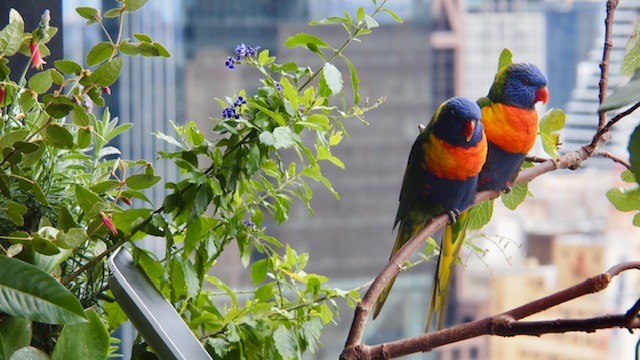
It’s small, but it hums with life. European honeybees from the Melbourne Central hives drop in for a sip, hover flies and moths stop by for a snack, and a shy house spider quietly manages the odd fly or a fungus gnat behind the air conditioner. A family of spotted collared doves has brought several generations to Anna’s home, alongside cheeky sparrows, raucous rainbow lorikeets and the occasional currawong. Even a peregrine falcon from Collins Street sometimes patrols the skyline above - a reminder that that nature finds its way, even among the rooftops. Read on to discover how Anna transformed her small garden space into a haven for wildlife.
Like many of us, I rediscovered the importance of green space during the long months of COVID lockdowns. That little balcony became my sanctuary. A place to breathe, nurture and connect with life beyond the walls of our apartment.
Despite my best efforts, the garden was struggling. Aphids, spider mites, mealybugs scale came in waves blown in by the wind. You name it, I had it. I adored the occasional lorikeets, but they weren’t exactly pulling their weight in the pollination department. I was pollinating my passionfruit and citrus with a paintbrush, and even the tomatoes looked unimpressed. That’s when Gardens for Wildlife came to the rescue.
In winter 2023, Gardens for Wildlife team members Katherine M and India visited my balcony to help me attract more beneficial birds and pollinators. They were warm, curious, and full of clever ideas. After a quick inspection, they suggested adding native grasses and native plants that could drape slightly over the balcony edge to create a visual cue to birds that it was safe to enter. Next weekend, I headed straight to Bili Nursery to get planting.
The transformation was almost immediate. The new greenery worked like a “Welcome” sign, and soon the air was alive with new feathered faces. My pests disappeared, my plants thrived, and my balcony finally began to feel like an ecosystem rather than an experiment.
In 2024, my balcony became a lorikeet holiday resort. At one point, I counted 43 of them taking shelter during hot weather, hanging from the grapevine, perching on pot rims, even sleeping in the empty planters on the potting table. It was as if a carnival of colour and song arrived and refused to leave.
Every evening after work, I’d scrub the balcony clean, laughing and occasionally muttering under my breath. It was messy, chaotic and absolutely wonderful. My neighbours began noticing lorikeets visiting their balconies too and we’d share stories in the hallway. The birds had brought a sense of community to our vertical village.
Eventually, the lorikeets moved on, after eating my grapevine and my grevillea down to the ground. As another Gardens for Wildlife gardener, Katherine H., once said, “They consumed their environment and left.” But they left behind balance. Once the crowd cleared, other birds like doves and sparrows could return.
Over the years, I’ve learned that wildlife gardening at altitude comes with its own rulebook, and a few hard-earned lessons.
Clean water is non-negotiable. If you have the room, a birdbath is lovely, just make sure it’s fixed firmly in place.In high-rises, anything that can blow away becomes a missile, so stability always wins over aesthetics.
I also like to help my feathered neighbours in more subtle ways sprinkling baked, crushed eggshells and a touch of garden lime (never builder’s lime!) into the soil to give them access to calcium. I put out a small basket of straw, dried cat grass and clean feathers during nesting season, helping young families line their homes safely without resorting to hair, string, or synthetic fibres that can cause injuries.
In the four years since I began paying closer attention to avian nutrition and foot health, I haven’t seen a single new deformity among the birds that visit. It’s a small personal triumph, and a reminder that even small acts of kindness can ripple through generations.
Our balcony faces west, so it’s a juggling act of sun, wind and heat. A quarter sits in permanent shade and the air-conditioner vents straight into it, adding an extra dose of “desert” dry heat. We can’t drill into the walls, so any hook relies on industrial-grade adhesive (and my ongoing faith in gravity). Not every plant survives, but I’ve learned to pick species that thrive in my peculiar microclimate, and to forgive myself for the occasional heartbreak.
My number one rule for other apartment gardeners: everything stays inside the railing. No exceptions. The goal is to create a safe haven, not launch pots into the people strolling the streets below.
Since my Gardens for Wildlife visit, my little sky garden has become something of a living experiment. I trade plants with friends, swapping backups in case one of ours doesn’t make it. I’ve even added a tiny waterlily pond with native snails, started by Katherine M’s terrarium project from a Gardens for Wildlife workshop. It’s become a small, shimmering hub of life and reflection.
Looking ahead, I hope to connect with like-minded neighbours to create a network of “balcony habitats”. We may not have backyards, but together, we can stitch patches of green into the concrete fabric of the city.
I might never get to eat my own figs, passionfruit, kumquats or grapes (the birds always win), but the joy of seeing new chicks, healthy wings and clean little feet makes it all worthwhile.
Lately, the peregrine falcons from Collins Street have discovered that our balcony is a convenient snack stop. They swoop by occasionally, startling our doves and lorikeets into flight.
It’s been seven years since I started my balcony garden. Seven years of learning. Gardens for Wildlife didn’t just help me grow plants; they helped me grow a community, a habitat and a sense of connection to something far bigger than my three and a half square metres of sky.
It turns out, with a bit of care, a lot of patience, and a sturdy mop, even a high-rise balcony can bloom into a home for wildlife.
Acknowledgement of Traditional Owners
The City of Melbourne respectfully acknowledges the Traditional Owners of the land we govern, the Wurundjeri Woi-wurrung and Bunurong / Boon Wurrung peoples of the Kulin and pays respect to their Elders past and present. We acknowledge and honour the unbroken spiritual, cultural and political connection they have maintained to this unique place for more than 2000 generations.
We accept the invitation in the Uluru Statement from the Heart and are committed to walking together to build a better future.