You can have your say any time on parking in your neighbourhood by completing the ‘always on’ survey. This feedback will inform future reviews and adjustments.
First annual review (2025)
The conversation
In 2023, the City of Melbourne released its Parking and Kerbside Management Plan, which committed to regular reviews of kerbside parking. These reviews include proactive engagement in our neighbourhoods and sharing the data that underpins decision-making.
The aim of this work is to make parking simpler and more available across our neighbourhoods, including the CBD. The cycle of regular reviews for the CBD began alongside the release of this plan, with key insights used to inform the first round of parking changes that were rolled out.
These new parking conditions were not ‘set and forget’. We’ve given time for the community to adjust and have now completed the next CBD parking review, using community feedback and transport data.
Additionally, in response to feedback we’ve received and data we’ve collected, we also refined some of the on-street changes ahead of this review being conducted.
Gathering insights
On-street works for the first round of parking changes in the CBD concluded in August 2024.
Since these works were completed, we’ve gathered insights and data on the changes to determine if any adjustments are required.
As part of the first annual review of parking conditions in the CBD we:
- Received and reviewed 50 survey responses via the ‘always on’ survey.
- 160 pieces of feedback or requests for further adjustments were received.
- Evaluated and monitored parking occupancy data, including parking meter transactions, in-ground sensor data and Easy Park transactions.
In total, 216 individuals or organisations provided direct feedback as part of this review, with valuable insights into their experience of parking in the city.
Community feedback about CBD on-street parking via the ‘always on’ survey has been low, which may indicate that parking controls are generally working well. However, to help us better understand community sentiment about how on-street parking in the CBD is functioning, further community engagement will undertaken to inform the next review.
We are committed to continuously improving our engagement and data collection processes to ensure the strategic directions of the Parking and Kerbside Management Plan are upheld.
What we found out
We reviewed key themes and feedback gathered through our ‘always-on’ survey, along with direct stakeholder input. We also analysed transport data and parking bay occupancy rates to understand how the parking changes performed.
CBD parking improvements review summary
Click each heading to learn more about what we heard on each topic.
Annual review findings:
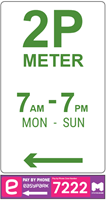
- Average occupancy is within the optimal range as defined in the Parking Kerbside Management Plan.
- Use of 2P spaces has increased by 56%, with comparatively fewer overstays. This indicates that the simplified and consistent parking controls we introduced are meeting more users’ needs.
- 7am-10pm parking controls reflect evening and weekend demand for parking, which helps increase turnover and available spaces.
- Small number of concerns raised about paying for parking early mornings (specifically Sunday) when occupancy is lower.
Recommended actions:
- Maintain current parking controls and continue to monitor data to inform any future adjustments
- Explore improvements to pricing model to better reflect changes in demand (for example, demand responsive pricing)
Annual review findings:
- Good level of usage and positive feedback received
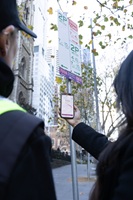
- Since the initiative began in the CBD in 2023, city drivers have enjoyed more than 15 million minutes of free parking and saved a total of more than $1.3 million in parking fees.
Recommended actions:
- In October 2025 ‘15 minutes free’ was rolled out at all paid parking bays across the City of Melbourne.
- Deliver additional communications about the offer to the community
Annual review findings:
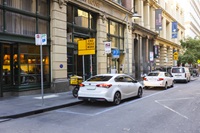
- Accessible parking spaces increased by 14%, with better coverage across the CBD
- Misuse of accessible parking spaces reduced by 20%
- Occupancy is at lower end of optimal range, which means very good availability
Recommended actions:
- Investigate opportunities for accessible pick up/drop off spaces at key CBD destinations
- Address any gaps identified in the accessible parking spaces network
- Improved communications about double time in any general parking space for accessible parking permit holders
- Continue engaging with Disability Advisory Committee and other stakeholders to raise awareness in the community
Annual review findings:
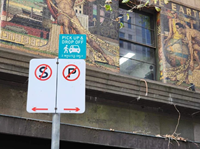
- Spaces are functioning as intended, with positive feedback received
Recommended actions:
- Undertake further data collection and engagement with key stakeholders (such as taxis, rideshare and hotels) to understand usage and promote further
- Explore installing signage facing the footpath side of these spaces, so it’s easier for pedestrians to identify safe pick-up spaces.
Annual review findings:
- Loading Zone spaces increased by 15%
- Average occupancy is within optimal range
- Average stay time is within acceptable range
- Peak usage well within operating hours (7am - 4pm)
- Some loading zones showing lower levels of usage
Recommended actions:
- Verify data for loading zones showing lower usage and assess whether loading zone still required in these locations
- Continue to engage with key freight industry stakeholders
Examples of what we heard
Responding to community feedback
The parking conditions that were rolled out were not ‘set and forget’. In response to feedback we’ve received and data we’ve collected, we refined some of the on-street changes ahead of the first CBD annual review being conducted. This enabled us to act on and bring forward improvements for the community.
Initially Loading Zones throughout the CBD were changed to 7am – 4pm weekdays. These would then become 2P parking spaces after 4pm to free up additional parking spaces.
Feedback: Stakeholders and businesses in a key 24-hour trading area gave us feedback that loading zones were needed outside the 7am-4pm period to service 24-hour trade.
Outcome: In September 2024, 24-hour Loading Zone bays were installed on the corner of Flinders Lane and Elizabeth Street. We also moved Loading Zone bays from less accessible small streets to support this busy retailer area. Stakeholder and business feedback has been positive after these changes.
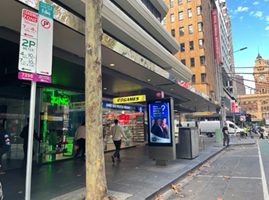
Feedback:
Community near the West Melbourne border of the CBD told us that CBD parking controls were not appropriate, and parking changes should reflect the residential nature of the area.
“This street is not CBD; it is residential and in West Melbourne.”
“We cannot leave work every 2 hours to top up the meter.”
Outcome:
Jeffcott Street and Batman Street were moved into the West Melbourne boundary and included in the 2024-2025 West Melbourne Parking Review.
As part of this parking review, both these streets had their parking controls updated in 2025 to better reflect usage in this residential area.
Next steps
We will investigate and implement the review actions where appropriate, monitor outcomes and continue to build our engagement approach to increase participation.
We will continue to monitor parking in the CBD and consider feedback ahead of the next scheduled review of CBD parking conditions, which will be held in 2027.
2023
The conversation
In 2023, the City of Melbourne introduced a Kerbside Parking Strategy that committed to regular reviews of the kerbside parking system based on proactive engagement in local areas and sharing the data that underpins decision-making.
Gathering insights
In the CBD, the cycle of regular reviews began alongside the development of the Parking and Kerbside Management Plan.
As the plan was developed, key insights were used to inform the first changes for parking in Melbourne CBD.
The formal community engagement period ran from 22 March to 19 April 2023 (four weeks). Pre-draft engagement occurred in October 2022 to inform the draft Parking and Kerbside Management Plan.
In total, 439 individuals or organisations provided direct input and feedback, in addition to the 971 people who were surveyed in relation to their experience of parking in the city, to support the development of the draft plan.
We won’t set and forget the new conditions. We will be back in the CBD in 2025 to see how initial changes have worked and hear from the community again.
Who we reached
People who responded to the survey were more likely to be men (52 per cent), under 50 years of age (61.5 per cent) and a City of Melbourne resident (52.88 per cent).
Most respondents travelled frequently within or to the City of Melbourne with 45 per cent noting they travel in the municipality every day. Respondents predominantly travelled by public transport or private vehicle as their usual mode of travel to the city. With 30 percent of respondents using private vehicle as their main mode of travel. This indicates a strong level of feedback from people who rely on vehicle access to the City of Melbourne.
Changes to taxi parking in the CBD were finalised after the taxi zone changes trial.
What we heard
People were asked to nominate the most important strategic challenges to be addressed in the Parking and Kerbside Management Plan.
The top responses were:
- 'There are competing needs for access to limited city space' (57.8 per cent of respondents selected this challenge)
- 'Drivers can have difficulty finding available on-street car parking space' (47.5 per cent)
- 'Parking rules and complex parking signage can be confusing' (42 per cent)
- 'There is a large supply of off-street parking in the city but it is underutilised' (37 per cent)
Examples of what we heard
Impact
We completed the roll out of improved parking conditions in the CBD in March 2024.
- Consistent two-hour (2P) time limit for all general parking spaces in the CBD, from 7am to 10pm every day.
- This changes a range of time limits in the CBD to two hours, simplifying parking conditions and the signs that communicate them.
- A two-hour time limit keeps more spaces turning over for people who need to park at the kerbside.
- Need to run a quick errand? Pay nothing for a short trip.
- When you use the EasyPark app you’ll pay nothing for a short stop (up to 15 minutes in any ‘green-signed’ parking space, like ‘2P Meter’). If you’re in and out within 15 minutes, we waive the parking fee.
- No fees are waived if you park longer than 15 minutes.
- This initiative helps to boost parking turnover.
- Off-peak parking rate of $4 per hour in the CBD after 7pm on weekdays and all weekend.
- The peak rate will remain at $7 per hour and apply to metered spaces until 7pm on weekdays. Demand has increased during these periods and this helps maintain parking turnover and availability for people needing to travel by car.
- Loading zones reviewed and repositioned to make sure we have the right spaces in the right locations.
- All loading zones will be a consistent 30 minutes to give drivers enough time to complete deliveries.
- Accessible parking spaces reviewed and repositioned to improve location and accessibility.
- Disability parking permit holders can also park for double the time limit shown on any general ‘green sign’ parking space (up to four hours in a ‘2P Meter’ space).
- Designated pick up / drop off spaces in every street.
- These are typically the first spaces after every intersection.
- You can use these ‘No Parking’ spaces to stop for up to two minutes if you stay within three metres of your vehicle.
- These spaces are easy to find and access, and perfect for if you’re picking-up or dropping-off passengers.
- Hundreds of spaces ‘unlocked’ across the CBD to make sure more public parking is available at the right time of day.
- We’ve also set parking conditions so that most loading zones become regular two-hour parking spaces after 4pm. This creates more parking options at peak times.
Next steps
We won’t set and forget the new conditions once works are complete; we'll give the community time to adjust and then review the functionality and performance of those changes.
You can have your say any time on parking in your neighbourhood by completing the survey. The next review of your neighbourhood will use this data to inform future changes.
We’ll give the community time to adjust, then review the changes to make sure the new parking conditions are working well.