Phase 4 (2025 - 2026)
The conversation
The Hawke Street greening project is a key initiative of the West Melbourne Structure Plan (2018). It seeks to reduce through-traffic and mitigate increased vehicle flow from the West Gate Tunnel, improve bicycle and pedestrian connectivity, and increase green space, making Hawke Street a better place to live and sustainably commute.
During the detailed design process following the third phase of community engagement, we found that the concept design endorsed by Council in 2023 posed challenges due to underground services, meaning it wouldn’t be possible to deliver this design in full.
We then worked on two new concept designs, both of which would make Hawke Street greener and more accessible for the community – these two designs are what we consulted on during phase 4.
Since 2021, the North and West Melbourne community has committed significant time and effort to discussions about how to achieve our collective aims.
Council officers have listened to what we heard during previous engagements, including the issues and concerns raised at the Transport Amenity Program information session on 20 November 2025, as well as the individual submissions we received following the session.
Gathering insights
Community consultation took place between 8 December 2025 and 8 February 2026. It involved a survey on Participate Melbourne and 3 pop up information sessions at Hawke and Curzon Street Reserve and Hawke and Adderley Street Park.
We asked the community about which of the two concept designs they preferred and why, as well as which features are most important to them.
The conversation took place through a series of questions on Participate Melbourne. The survey was designed to understand if community members preferred either (or neither) of the two design options, and what they liked about the features of the option the selected. We also gave respondents the opportunity to identify concerns they had with either option.
Given the hyper local focus of this project, the survey began with a question to establish the participant’s connection to Hawke Street, with options including residents of Hawke Street or of the surrounding areas, business owners, workers, or someone who commutes through the street. Understanding the preferences, needs and concerns of the local community with lived experience of the area was very important.
Who we reached

were received via Participate Melbourne

had with the community participants

What we heard
Preferred design option:
Key findings and observations
Recurring themes emerging from additional feedback provided suggested that safety, greening and parking important to the community.
Key themes include:
- canopy cover, such as the retention of mature trees and canopy cover
- car parking, including changes to car parking and the negative impacts of additional losses
- cyclist priority / safety and the prioritisation of safety for cyclists on and around Hawke Street
- general street greening and biodiversity
- impacts to traffic flow such as rat running, the removal of traffic lanes and increases in car traffic
- the removal or retention of the median strip
- the prioritisation and safety of pedestrians on and around Hawke Street
- protected bike lanes that separate bikes from the street
- existing examples such as Roden Street as a well-executed street-greening project
- greening on the south side of Hawke Street between King Street and Spencer Street
- sentiment promoting traffic calming measures - such as speed bump, speed limit
- traffic accessibility through local roads.
Impact
The development of the recommended design option, which is a refined version of design option two, considers the feedback and concerns raised through the consultation process. This design option was endorsed by the Future Melbourne Committee on Tuesday 19 May 2026.
Next steps
The project will now move through a detailed design process before construction begins in early 2027.
Read the engagement summary report

Phase 3 (Dec 2021 - Jan 2022)
The conversation
Following the community workshop on 8 December, we went out for wider community consultation from 20 December 2021 to 18 January 2022.
The purpose of this phase was to get feedback on the proposed updated design of Hawke Street Linear Park and understand community sentiment.
We wanted to find out from residents and local community:
- How they think the park space will be used.
- What design features, treatments and placements would they like to see access/restrictions.
- Where further consultation is needed.
- What opportunities are there to amend parking conditions in the area.
- Any residual concerns and areas to improve before the development stage begins.
Who we reached

residents attended focus groups and interviews

representatives from Hawke Street businesses
website visits

responses to the online survey
What we heard
Key issues
- The reduction of car parking was first and foremost the dominant issue raised in the concept design for Hawke Street. There were several specific aspects to this issue raised.
- There were numerous questions and comments on the impact of changing traffic conditions. These centered around how calming techniques on Hawke Street will drive traffic elsewhere in the area.
- Residents identified shared concerns about impacts of design on home with new traffic layout.
- Businesses and residents expressed concern about the construction impacts on their community. They suggested implementing the scheme in one go to reduce disruptions.
How would you like to see the new and upgraded parkland used?
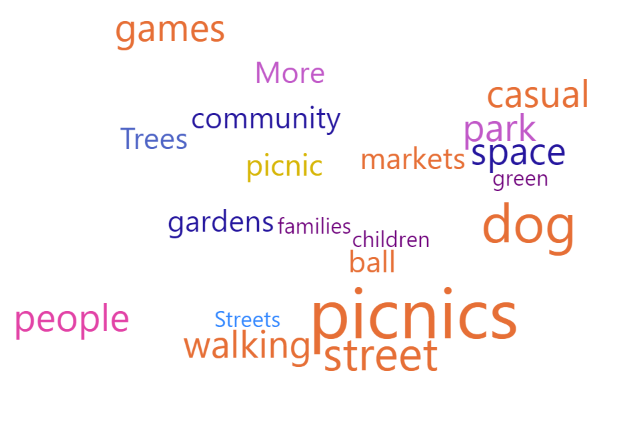
Word cloud illustrating commonly used words in the survey.
The feedback received included:
Impact
Capire Consulting Group recommended a detailed car parking study of the West Melbourne local area conducted in 2022. The study should determine requirements of residents and businesses, how the area caters for visitors, the level of compliance achieved and analyse how well the residential parking scheme is working in the area.
Next steps
Taking on board the community and businesses concerns and opportunities identified during this consultation, a concept design was endorsed by the Future Melbourne Committee in May 2023.
We are now creating a detailed design and project planning.
Follow this page to receive the latest updates.

Phase 2 (Dec 2021)
Community workshop
On 8 December 2021, we invited the Hawke Street community to join an on-site workshop where they could meet the design team and discuss current planning for the linear park project. We had urban and landscape planners, as well as parking and traffic experts, available to answer questions and host a walking tour of key locations.
Thirty-eight people attended and shared their views on the current plans.


Document Library
Phase 1 (Mar-Apr 2021)
The conversation
In early 2021, we spoke with Hawke Street locals and visitors about our proposal to enhance the quality and function of public space in Hawke Street, West Melbourne.
We sought feedback on a new linear park, reducing through traffic and on-street parking to gain a new connected green public space.
Gathering insights
From 26 March to 25 April 2021 we encouraged the community to provide feedback by completing an online survey, sending an email or letter, or by phoning to speak directly to the Transport and Amenity Program team.

E-newsletters sent
Letters sent
Website visitors
Surveys completed
What we heard
This initial concept plan was supported by 73 per cent of survey respondents. There was a positive response from community about the increase in open green space and improvement to pedestrian and cycling connections. A small number of responses reported deep dissatisfaction with the reduction of local car parking space along Hawke Street. The reduction of car parking was noted to have a large impact on residents and businesses already struggling to park near their home or office.
The feedback received included:
Impact
Community feedback was compiled by independent data analysts and presented back as a Consultation Summary. What we heard was used to help develop a more detailed concept plan.
A six-month parking review was also commissioned for Hawke Street, comparing weekday and weekend activity. This helped us better understand street parking utilisation and behaviours.